Analyst: Fail-Safe
At the end of M4, the following dialogue takes place:
| Neo: We have a few questions.
Trinity: You tried to activate the fail-safe.
Analyst: The Suits tried. Obviously, without control of your source code, I knew that was impossible.
Trinity: So, why haven t the Suits purged you? |
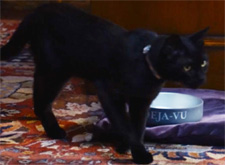 Deja Vu (the Analyst's black cat) serves a critical purpose in the Analyst's version of the Matrix. It functions as a kind of administrative "security key" or control mechanism—likely required to enact major changes, such as altering bluepill memories, repairing structural damage, or triggering resets when the system destabilizes. This builds on the original Matrix film's use of déjà vu (and the black cat) as a glitch signaling code alterations. In M4, Sati references the fail-safe being triggered by Neo's escape, but the Analyst intervenes, convincing the higher machine authorities ("the Suits") that Neo would return voluntarily to protect Trinity. The cat appears tied to this: after Neo is shot by Smith, the Analyst remakes reality, and Neo awakens to the sound of Deja Vu's bells. In the climactic Simulatte fight, the Analyst desperately tries to reach Deja Vu, but the cat flees amid the chaos, preventing him from regaining full control.
Deja Vu also serves a second purpose in M4: the obligatory villain's cat, imitating the famous cat always held by James Bond's arch nemesys, Ernst Stavro Blofield (leader of the organization Spectre), or any number of other villain cats (Enter the Dragon, Inspector Gadget, The Godfather). Right on cue, when Neo falls into the Analyst's trap in Trinity's garage, just like with James Bond villains, the Analyst discloses his plan to Neo even though doing so isn't strategically necessary - how he manipulates Neo through bullet time, how he extracts power from Neo and Trinity, etc.
But to be perfectly honest, I think there is a bigger purpose to these lines. Before I say what that purpose is, let me explain the clues that pushed me to this conclusion. For one thing, after Neo says, "We have a few questions," Trinity doesn't ask a question. She makes a false accusation ("You tried to activate the fail-safe"), and the Analyst corrects it. What makes Trinity's accusation even more odd: why would it bother Neo and Trinity if the Analyst tried to activate the fail-safe? If the fail-safe resets the Matrix back to version 7.0, a Matrix model that gives humans in the Matrix more freedom since they have authentic choice, wouldn't that be a good thing? If Neo or Trinity could have triggered it by capturing Deja Vu, surely they would have triggered it themselves. Accusing the Analyst of triggering the fail-safe, or bringing up the fact that it was triggered at all, seems a little strange.
Where did this lead me? I believe these two lines serve as a conclusion to all the self-reflective "meta" stuff in the beginning: they serve as a message from Lana Wachowski to you and me, telling us that once Warner Bros. (the "suits") read the wacky, hyper-meta script of M4, Warner Bros. saw that the sequel wasn't going to show the respect to the franchise's own loyal, core audience that they deserve, and the "suits" tried to do everything they could (rightfully so) to cancel the movie and/or have other writers revise it (they tried to activate the fail-safe, to reset the movie franchise back to what it was, as a standalone trilogy and nothing more). Warner Bros. ultimately did not have control over the script itself (Neo's source code), probably due to a contract negotiated 20 years ago, so Warner Bros. didn't have any ability to... pull the plug, so to speak. If my speculation is correct, I would be more disappointed by Lana Wachowski for being so willing to taint the artistic perfection that the first three movies are and to use you and me as tools to engage in behind-the-scenes politics (highly disrespectful to the audience), than I would be at Warner Bros. for forcing a sequel to be made with or without the Wachowskis.
| 
Analyst |
| 
Morpheus |
|